Sunday, January 15, 2012
JK
Sunday, January 15, 2012
JK
Sunday, January 8, 2012,
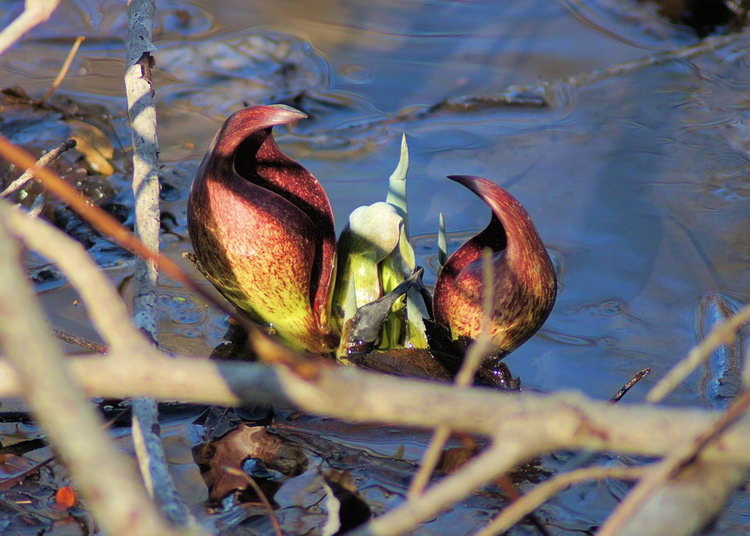
Here is a curious thing. These are pics of Eastern Skunk Cabbages I found on January 3rd at Morton Wildlife Refuge in Sag Harbor. Now, skunk cabbages are pretty cool on their own merits – we’ll get to that – but the curious thing here is that these plants are generally not seen till February at the earliest. Three days into the year has got to be too soon for these guys to be emerging. In fact, I was so sure that it was too early to be seeing skunk cabbages that I sent the pics to Isabel at Sweetbriar Nature Center. She confirmed my guess and said that the weather is confusing the plants. I think she’s right.
Skunk cabbages are usually the first flowering plants to emerge from the ground. Both John Eastman in Swamp and Bog and John Turner in Exploring the Other Island give February as when this plant should be making its debut. Maybe it’s this mild weather we’ve been experiencing but we haven’t actually had a winter yet.
The really amazing thing about these plants is that they are able to generate their own heat, enough even, to melt the snow. I know, big deal, right? I, too, can melt snow and I can write my name at the same time, but think about it: this is a plant that can melt ice. How cool is that? It’s that ability that allows it to appear so early in the season. But January? This has to be too early.
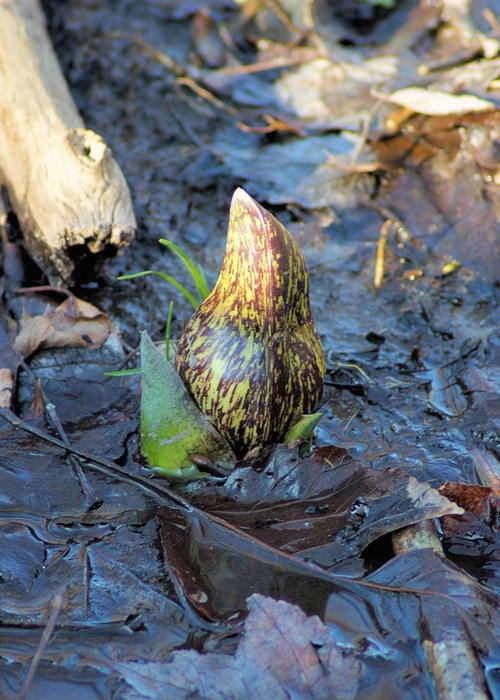
I sent the pics to some of my friends at Four Harbors Audubon Society to get their opinions.
Sue B. said, “weird and cool.”
Michele cried, “Invasion of the Body Snatchers!”
Elaine made comparisons to Audrey, the carnivorous plant from Little Shop of Horrors.
Indeed, at this point the plant does have a rather otherworldly look about it. Believe it or not, this is the flowering stage. Yep, this is as pretty as this plant gets. As Elaine explained to me, “The reddish spike you see is the “spathe”, an adapted bud which never opens to reveal its flower within. There’s just enough space between its closed “petals” to allow air to circulate from its warm center and provide an odorous current that visiting, pollinating insects will explore.”
Pretty cool stuff about a pretty cool-looking plant. JK
Saturday, December 31, 2011,

This is an off-topic post, I admit. Generally my pics are all about wildlife or nature but this is a scene I came upon while looking for wildlife. Plus, it’s a cool pic so why not share it here? Not to mention that I’m a little short of pics to post at the moment.
Three days back I took a drive over to West Meadow Beach. I was hoping to find some loons or maybe some wintering ducks but I didn’t see any. It was a beautiful day but the wind was barreling in from the northwest at over 25mph. While the ducks were probably seeking the shelter of calmer waters some folks saw the very same conditions as a reason to get out and play. This is just one of about eight or nine guys that were zipping back and forth along the beach. It looked like a lot of fun but that wind was brutal. After ten minutes or so I retreated to the refuge of my car and turned up the heat. I may have missed out on the ducks but I think maybe I saw some loons. JK
Monday, December 19, 2011,
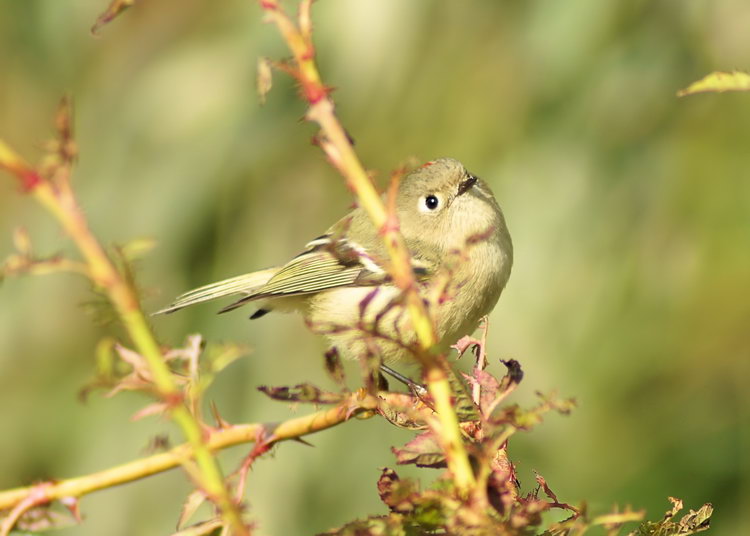
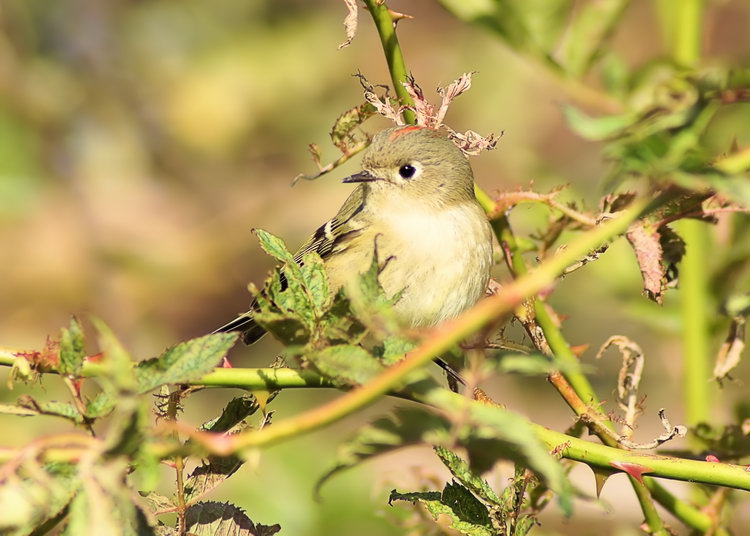
Here are some pics I took of a Ruby-crowned Kinglet at the end of October. Halloween, actually. These tiny guys are wintering here. I’m freezing my butt off and they’re here to enjoy the balmy weather. Go figure.
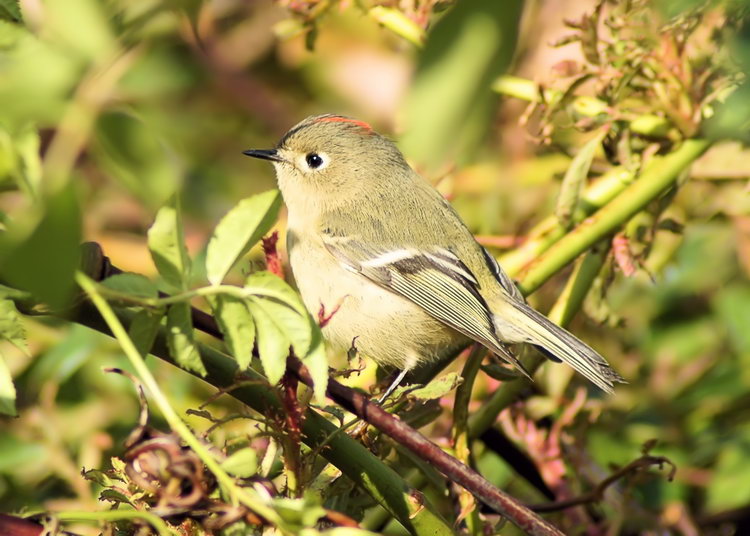
Can you see that narrow red stripe along the top of his head? That’s its ruby crown. That stripe also identifies it as a male because the females lack that bit of color. Look, the ladies have more to worry about than wearing fancy colors, okay? Not a one of those fancy-headed males has to carry around five to eleven eggs come breeding time, do they? That’s right, these micro-birds, as Kaufman calls them, lay a heck of a lot of eggs. Just not around here. You’ll have to go much further north to see that. In the meantime, enjoy these guys while they’re here.
JK
Monday, December 12, 2011,
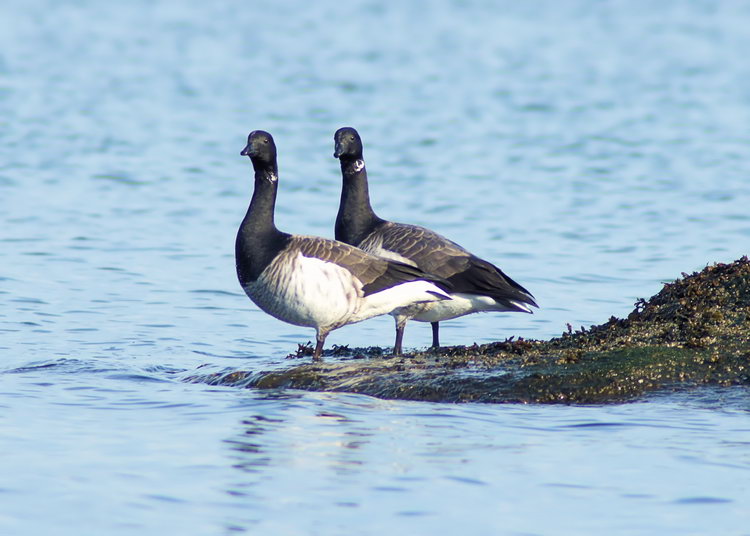
I snapped these pics on a recent hike through David Weld Sanctuary. The far end of the sanctuary offers a terrific view of the Long Island Sound. There’s also a path that leads down to the shoreline. When I saw from above that there were Brants in the water I took took the trail down to see if I could grab some pics.
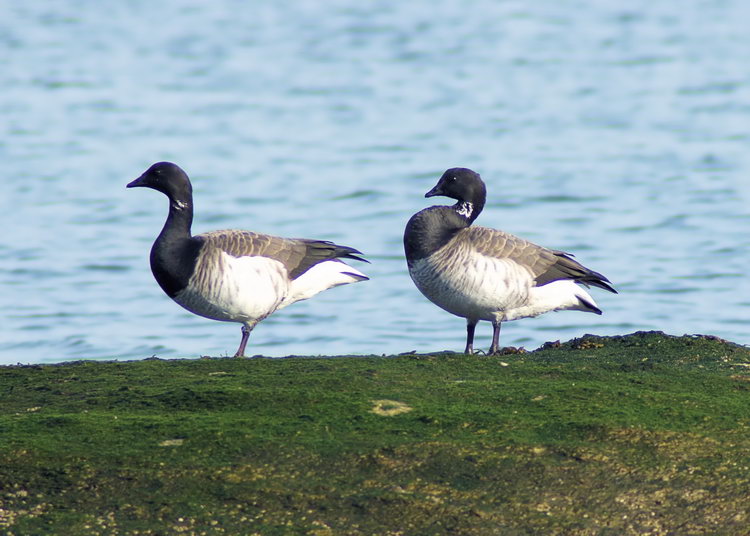
The north shore of Long Island is littered with rocks, from pebbles to boulders, the result of glaciation. In fact, most of Long Island, with the notable exception of the south shore, is the direct result of a glacier carving up the Atlantic seaside. To take these pics I hid behind a large boulder on shore.These geese are on another boulder that is a bit further off shore. I would sneak a peek, take a shot, and scoot behind the boulder. Sneak, shoot, scoot, repeat. Who says wildlife photography is boring? JK